Popular Posts

Pages

Saturday, August 27, 2011

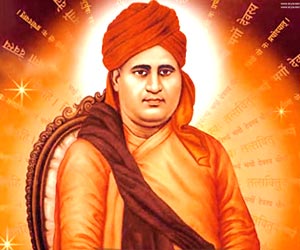
Dayanand Saraswati

Dayanand Saraswati

Born: 1824

Died: 1883

Achievements: Founded Arya Samaj and established gurukuls to impart vedic education.

Dayanand Saraswati was one of the most radical socio-religious reformers in the history of India. Swami Dayanand Saraswati was the founder of Arya Samaj and propagated egalitarian approach of the Vedas at a time when widespread casteism was prevalent in the society.

Swami Dayanand Saraswati's original name was Mool Shankar Tiwari. He was born in 1824 in Tankara, Gujarat in a rich family of Brahmins. As a child Dayanand was brought up under the strictest Brahmin rule, and at the age of eight was invested with the Sacred Thread (Upanayna). When he was fourteen his father took him to the temple on the occasion of Shivaratri. Dayanand had to fast and keep awake the whole night in obedience to Lord Shiva. In the night he saw a rat nibbling the offerings to the God and running over Shiva's body. He tried to find out from elders why this "God Almighty" could not defend himself against the menace of a petty mice, for which he was rebuked. This incident shattered Daya Nand Saraswati's faith in the idol worship and thereafter he refused to participate in the religious rites for the rest of his life.

At the age of nineteen Dayanand Saraswati ran away from home to escape from a forced marriage. He was caught and imprisoned. He fled again in1845. For fifteen years he wandered all over the country in the search of a guru. In 1860, he found his guru and mentor Swami Virjanand Saraswati at Mathura. He was blind. Dayanand Saraswati underwent rigorous training under Swami Virjanand Saraswati. Virjanand Saraswati gave him the name Dayanand and as gurudakshina extracted promise from Dayanand that he would devote his life for revival of Hinduism.

Dayanand Saraswati undertook a tour of the entire county, made fiery speeches condemning the caste system, idolatry, and child marriages. He advocated the ideal age for a girl to be between 16 and 24, and for men between 25 and 40. Dayanand Saraswati was the first leader in the field of theology who welcomed the advances of sciences and technology. To him, the Vedas as the source book contain the seed of science, and to him, the Vedas advocate the philosophy of dynamic realism.

Dayanand Saraswati founded Arya Samaj in Mumbai in 1875 to promote social service. Arya Samaj, postulates in principle equal justice for all men and all nations, together with equality of the sexes. It repudiates a hereditary caste system, and only recognizes professions or guilds, suitable to the complementary aptitudes of men in society. He gave new interpretations to reform the stagnant Hindu thought through his book "Satyaprakash" (The Light of Truth). He profusely quoted the vedas and other religious texts to insist that salvation was not the only motto of a Hindu or Arya, as was believed. To lead a fruitful worldly life, working for a noble cause was important, and he preached that salvation was possible through social service.

Due to his radical thought, Swami Dayanand had acquired enemies from all spheres of life. On the occasion of Deepavali in 1883, he was a guest of the maharaja of Jodhpur. The king was a womanizer and Dayanand advised the king to lead a righteous life as a ruler, upsetting a mistress by the name of Nanhi Jan. That night Swami Dayanand was poisoned during the festival meal. Swami Dayanand Saraswati breathed his last chanting "Om".

Anna Hazare

Born On: June 15, 1937

Born In: Bhingar, Bombay Province

Career: Social Activist

Nationality: Indian

His only motive in life lies in service of his fellow humans. His fight against corruption has been basically targeted at uplifting the poor and downtrodden conditions prevailing in rural India. His supporters call him "Second Gandhi". He is Anna Hazare, an ex-army man and a social activist, recognized and celebrated for his undying support for the citizens of India to serve them and fight for them against greed and corruption. His journey of four decades, right from a tenacious army soldier to a social reformer, is regarded as an unprecedented campaign of resurrecting India as a strong nation. By upgrading the ecology and economy of the Ralegan Siddhi village, sited in drought-prone Ahmednagar district of Maharashtra state, Hazare has played a significant role in transforming this poverty clad hamlet into one of the richest villages in India. Recently, he has earned name and fame for fighting for the implementation of the Jan Lokpal Bill, the anti-corruption bill drafted by his crusaders to deal with the corruption prevalent in the government of India at the highest level.

Early Life

Anna Hazare was born as Kisan Baburao Hazare to Baburao Hazare, an unskilled laborer in Ayurveda Ashram Pharmacy, in the village of Bhingar near Hinganghat city in Bombay Province, presently in Maharashtra. After his grandfather's death in 1945 who served in the Indian army, his father continued working in Bhingar till 1952, after which he resigned and returned to his ancestral home in Ralegan Siddhi. Due to financial hardships, Anna Hazare was looked after by his childless aunt who took him to Mumbai and funded his education. Here in Mumbai, he studied till class seven and took up employment to support his family. A job that started as selling flowers in Dadar culminated into owning a flower shop and calling upon two other brothers to Mumbai.

Service in the Indian Army

The Indian soldiers who turned martyrs in the Indo-China War of 1962 urged the government to recruit young Indians in the Indian army on emergency basis. Highly inspired by patriotism and love for his country, Anna Hazare joined the Indian Army in 1963, despite not fulfilling the physical requirements. Here began his career as an Indian army soldier, starting as a truck driver, after successful training at Aurangabad in Maharashtra. When Pakistan attacked India in 1965, he was posted at Khem Karan border, where all his comrades turned martyrs, but Anna managed to survive a close shave as a bullet just passed by his head. This incident forced him to think upon the existence of humans and meaning of life and death. Swami Vivekananda proved to be a great inspiration for him, post reading the small booklet "Call to the youth for nation building" he found at a book stall at the New Delhi railway station. It was at this point that he decided to dedicate his entire life for serving humanity. He was just 26 at that time. However, having completed only three years in the army would not have made him eligible for the pension scheme, which is why he continued to serve in the army for 13 long years, after which he took voluntary retirement from the army in 1975 and returned to his native place, Ralegan Siddhi. During his tenure as a soldier, he served in different states, like Sikkim, Bhutan, Jammu & Kashmir, Assam, Mizoram, Leh, and Ladakh.

Upliftment of Ralegan Siddhi

During his tenure in the Indian Army, Anna Hazare visited Ralegan Siddhi every year for two months and was highly moved by the miserable condition of the farmers residing there. On retirement, he went back to this drought-prone and rain-shadow zone of Ahmednagar district and pledged to develop the village. He came across the novel project of water management through watershed development undertaken by Vilasrao Salunke, a resident of Saswad near Pune. Motivated by the project, he decided to implement the same in his village to eradicate water scarcity. The project was successful in increasing the ground water level and providing water to 1500 acres of land, instead of the meager 70 acres previously. As a result, the farmers produced good yield of food grains and the village became self-sufficient. Eventually, Anna Hazare brought about several economic changes leading to establishment of a school, a temple, a hostel, and other buildings. Mass marriages, Grains Bank, dairy, cooperative society, self-help group for women, and youth mandals followed next to give the village a new and improved face. This village became a model village for numerous other oppressed villages, and has been regarded as a tourist spot for people from across the country till date.

Social Life

Bhrashtachar Virodhi Jan Aandolan (BVJA), or People's Movement against Corruption, was started by Anna Hazare in 1991 as an attempt to fight against corruption that was blocking rural development in India. Hunger strikes became his tool of protest with high-profile politicians being his target. The movement found 42 forest officers guilty for duping hundreds of crores through corruption. Even though Anna Hazare handed over the evidences to the government, the government was reluctant in taking action against the culprits since some officers of the ruling party were themselves involved in the scam. Distressed and heart-broken, Anna Hazare protested and was imprisoned, a step that was supported by all social activists and political leaders of all parties, except BJP and Shiv Sena. To force the government raise charges against another set of political leaders, he began his fast unto death on August 9, 2003, which ended on August 17, 2003 with the then chief minister Sushil Kumar Shinde forming a one-man commission to find evidence against the convicts.

Right to Information Movement

Envisioning that action against fraudulent ministers and officers was not sufficient to fight back corruption, Anna Hazare campaigned for the Right to Information Act in 1997 which was turned down by the state government. To protest against the result, he agitated at Azad Maidan in Mumbai and then traveled across the state to create mass public awareness. Realizing that the government has turned blind, he went on an indefinite hunger strike in July 2003. His protest compelled the President of India to sign the draft of the Right to Information Act after 12 days of hunger strike. The act was put to order with effect from 2002 and formed the base for the National Right to Information Act, 2005.

Lokpal Bill Movement

The most touted protest among all the remonstrations campaigned by Anna Hazare against the Indian government is the Lokpal Bill Movement, or People's Ombudsman Bill, which was initiated in April 2011. This anti-corruption bill was drafted by N. Santosh Hegde, a former justice of the Supreme Court of India and Lokayukta of Karnataka; Prashant Bhushan, a senior lawyer at the Supreme Court; and Arvind Kejriwal, a social acitivist, along with other members of the India Against Corruption movement. The bill included more stringent provisions and wider power than the Lokpal Bill prepared by the government in 2010. In support of getting the bill approved, Anna Hazare began his fast unto death on April 5, 2011 at Jantar Mantar, New Delhi, after his demand for a more independent Jan Lokpal Bill was rejected by the Indian Prime Minister, Manmohan Singh.

Hazare's hunger strike and anti-corruption campaign was supported by thousands of people and social activists, such as Medha Patkar, Arvind Kejriwal, former IPS officer Kiran Bedi, and Jayprakash Narayan. The hunger strike ended on April 8, 2011 after the government agreed to give into the demands. Prime Minister, Manmohan Singh stated that the bill would be re-introduced in the monsoon session of the Parliament. This resulted in the issue of a notification in the Gazette of India on April 9, 2011 to form a joint committee, comprising of five nominee ministers of the Government of India and five nominees of the civil society. The five nominee ministers of the Government of India included Pranab Mukherjee, P. Chidambaram, M. Veerappa Moily, Kapil Sibal, and Salman Khursheed. From the civil society Anna Hazare, N. Santosh Hegde, Shanti Bhushan, Prashant Bhushan, and Arvind Kejriwal, represented as the five nominees.

Meanwhile, on 5 June 2011, Swami Ramdev and his followers went on a hunger strike against the issues of black money and corruption, doubting seriousness of the government in taking measures to eradicate corruption. But they were forcibly evicted from the Ramlila Maidan by Delhi Police. As a retort, Anna Hazare and other civil society members boycotted the meeting of the joint Lokpal Bill drafting committee scheduled on June 6, 2011. They even asked the government to make its stand on the contentious issues related to the proposed draft legislation public. The group also declared that the future meetings would be attended only if they were telecast live. What followed next was the grand march on June 8, 2011 at Rajghat, wherein Anna Hazare threatened to go on an indefinite hunger strike, if the government tried to discredit the joint Lokpal Bill drafting committee and did not pass the bill.

On July 28, 2011, the union cabinet approved a draft of the Lokpal Bill, but what came out was a weak version of the original proposed bill. Not only did the government version kept the Prime Minister, judiciary and lower bureaucracy out of the ambit of the proposed corruption ombudsman Lokpal, but the drafted bill limited the powers of Lokpal to being just an Advisory Board. It stated that the Lokpal would have no police powers and no ability to register an FIR or proceed with criminal investigations. Furthermore, the drafted Lokpal bill affirmed that the Lokpal would have no power to initiate suo motu action or receive complaints of corruption from the general public. It could only probe complaints forwarded by the Speaker of the Lok Sabha or the Chairman of the Rajya Sabha. Eventually, as expected, Hazare rejected the government version of the bill and avowed that he would go on an indefinite fast from August 16, 2011 at Jantar Mantar if the government introduced its own version of the bill in Parliament without taking suggestions from civil society members

Just four hours before the planned hunger strike on August 16, 2011. Anna Hazare was arrested and imprisoned at Tihar Jail, though he started his fast inside the jail itself. Although he was granted judicial detention after 24 hours, he refused to come out, asking the government to approve of his demands for an unconditional permission to fast at Jaiprakash Narain Park. Also, he accepted neither of the two proposals laid down by Delhi Police, which were either stage a fast for a maximum of three days with a limited number of supporters (5, 000) or return to his hometown in Maharashtra. Rejecting both the proposals, Hazare preferred to remain in the Tihar Jail until his demands were met, saying he would leave the jail only if the government unconditionally allowed his protest for a stronger Lokpal Bill. Succumbing to the mounting pressure, the government of India has agreed for a 15-day fast at the Ramlila Ground, with no limitation on the number of supporters. Reportedly, a huge mass of supporters is expected to be at the Ramlila Ground to proffer their support towards this willful and determined social activist and India's "second freedom struggle" in terms of Anna Hazare.

Awards & Recognition

Indira Priyadarshini Vrikshamitra Award, 1986

Krishi Bhushana Award, 1989

Padma Shri, 1990

Padma Bhushan, 1992

Shiromani Award, 1996

Mahaveer Award, 1997

CARE International Award by CARE relief agency, 1998

Integrity Award by Transparency International, 2003

Honorary doctorate by Gandhigram Rural University, 2005

Jit Gill Memorial Award by World Bank, 2008

Timeline

1937: Born in Bhingar, Bombay Province

1952: Went to Bombay with his aunt

1963: Selected as a truck driver in the Indian Army

1965: Survived the air attack by Pakistan during Indo-Pakistani War

1975: Voluntarily retired from the Indian Army

1990: Felicitated with the Padma Shri

1991: Launched the Bhrashtachar Virodhi Jan Aandolan (BVJA)

1992: Received the Padma Bhushan

1997: Campaigned for the Right to Information Act (RTI Act)

2003: Began an indefinite hunger strike to get the RTI Act approved

2003: Went on a fast unto death from August 9 to August 17 as a protest against corrupt political leaders

2011: Initiated the Jan Lokpal Bill in April

2011: Arrested on August 16 before heading for the indefinite fast and imprisoned

Shaheed Bhagat Singh Biography

Born: September 27, 1907

Martyrdom: March 23, 1931

Achievements: Gave a new direction to revolutionary movement in India, formed 'Naujavan Bharat Sabha' to spread the message of revolution in Punjab, formed 'Hindustan Samajvadi Prajatantra Sangha' along with Chandrasekhar Azad to establish a republic in India, assassinated police official Saunders to avenge the death of Lala Lajpat Rai, dropped bomb in Central Legislative Assembly along with Batukeshwar Dutt.

Bhagat Singh was one of the most prominent faces of Indian freedom struggle. He was a revolutionary ahead of his times. By Revolution he meant that the present order of things, which is based on manifest injustice must change. Bhagat Singh studied the European revolutionary movement and was greatly attracted towards socialism. He realised that the overthrow of British rule should be accompanied by the socialist reconstruction of Indian society and for this political power must be seized by the workers.

Though portrayed as a terrorist by the British, Sardar Bhagat Singh was critical of the individual terrorism which was prevalent among the revolutionary youth of his time and called for mass mobilization. Bhagat Singh gave a new direction to the revolutionary movement in India. He differed from his predecessors on two counts. Firstly, he accepted the logic of atheism and publicly proclaimed it. Secondly, until then revolutionaries had no conception of post-independence society. Their immediate goal was destruction of the British Empire and they had no inclination to work out a political alternative. Bhagat Singh, because of his interest in studying and his keen sense of history gave revolutionary movement a goal beyond the elimination of the British. A clarity of vision and determination of purpose distinguished Bhagat Singh from other leaders of the National Movement. He emerged as the only alternative to Gandhi and the Indian National Congress, especially for the youth.

Bhagat Singh was born in a Sikh family in village Khatkar Kalan in Nawanshahar district of Punjab. The district has now been renamed as Shaheed Bhagat Singh Nagar in his memory. He was the third son of Sardar Kishan Singh and Vidyavati. Bhagat Singh's family was actively involved in freedom struggle. His father Kishan Singh and uncle Ajit Singh were members of Ghadr Party founded in the U.S to oust British rule from India. Family atmosphere had a great effect on the mind of young Bhagat Singh and patriotism flowed in his veins from childhood.

While studying at the local D.A.V. School in Lahore, in 1916, young Bhagat Singh came into contact with some well-known political leaders like Lala Lajpat Rai and Ras Bihari Bose. Punjab was politically very charged in those days. In 1919, when Jalianwala Bagh massacre took place, Bhagat Singh was only 12 years old. The massacre deeply disturbed him. On the next day of massacre Bhagat Singh went to Jalianwala Bagh and collected soil from the spot and kept it as a memento for the rest of his life. The massacre strengthened his resolve to drive British out from India.

In response to Mahatma Gandhi's call for non-cooperation against British rule in 1921, Bhagat Singh left his school and actively participated in the movement. In 1922, when Mahatma Gandhi suspended Non-cooperation movement against violence at Chauri-chaura in Gorakhpur, Bhagat was greatly disappointed. His faith in non violence weakened and he came to the conclusion that armed revolution was the only practical way of winning freedom. To continue his studies, Bhagat Singh joined the National College in Lahore, founded by Lala Lajpat Rai. At this college, which was a centre of revolutionary activities, he came into contact with revolutionaries such as Bhagwati Charan, Sukhdev and others.

To avoid early marriage, Bhagat Singh ran away from home and went to Kanpur. Here, he came into contact with a revolutionary named Ganesh Shankar Vidyarthi, and learnt his first lessons as revolutionary. On hearing that his grandmother was ill, Bhagat Singh returned home. He continued his revolutionary activities from his village. He went to Lahore and formed a union of revolutionaries by name 'Naujavan Bharat Sabha'. He started spreading the message of revolution in Punjab. In 1928 he attended a meeting of revolutionaries in Delhi and came into contact with Chandrasekhar Azad. The two formed 'Hindustan Samajvadi Prajatantra Sangha'. Its aim was to establish a republic in India by means of an armed revolution.

In February 1928, a committee from England, called Simon Commission visited India. The purpose of its visit was to decide how much freedom and responsibility could be given to the people of India. But there was no Indian on the committee. This angered Indians and they decided to boycott Simon Commission. While protesting against Simon Commission in Lahore, Lala Lajpat Rai was brutally Lathicharged and later on succumbed to injuries. Bhagat Singh was determined to avenge Lajpat Rai's death by shooting the British official responsible for the killing, Deputy Inspector General Scott. He shot down Assistant Superintendent Saunders instead, mistaking him for Scott. Bhagat Singh had to flee from Lahore to escape death punishment.

Instead of finding the root cause of discontent of Indians, the British government took to more repressive measures. Under the Defense of India Act, it gave more power to the police to arrest persons to stop processions with suspicious movements and actions. The Act brought in the Central Legislative Assembly was defeated by one vote. Even then it was to be passed in the form of an ordinance in the "interest of the public." Bhagat Singh who was in hiding all this while, volunteered to throw a bomb in the Central Legislative Assembly where the meeting to pass the ordinance was being held. It was a carefully laid out plot, not to cause death or injury but to draw the attention of the government, that the modes of its suppression could no more be tolerated. It was decided that Bhagat Singh and Batukeshwar Dutt would court arrest after throwing the bomb.

On April 8, 1929 Bhagat Singh and Batukeshwar Dutt threw bombs in the Central Assembly Hall while the Assembly was in session. The bombs did not hurt anyone. After throwing the bombs, Bhagat Singh and Batukeshwar Dutt, deliberately courted arrest by refusing to run away from the scene. During his trial, Bhagat Singh refused to employ any defence counsel. In jail, he went on hunger strike to protest the inhuman treatment of fellow-political prisoners by jail authorities. On October 7, 1930 Bhagat Singh, Sukh Dev and Raj Guru were awarded death sentence by a special tribunal. Despite great popular pressure and numerous appeals by political leaders of India, Bhagat Singh and his associates were hanged in the early hours of March 23, 1931.

Saturday, August 20, 2011

Manmohan Singh Biography and Resume


A Biography of Manmohan Singh


Manmohan Singh (26 Sep 1932 - present) is the 14th and accepted Prime Abbot of India. Admired by some as the "most educated" Indian Prime Abbot in history, Singh is a affiliate of the Indian National Congress party, and became the aboriginal Sikh Prime Abbot of India on May 22, 2004. He is advised one of the best able and affecting abstracts in India's contempo history, mainly because of the bread-and-butter reforms he had accomplished in 1991 back he was Accounts Abbot beneath Prime Abbot Narasimha Rao.

Early activity

He was built-in on 26 September 1932, in Gah, Punjab (now in Chakwal District, Pakistan). He has an Undergraduate (1952) and a Master's amount (1954) from Panjab University, Chandigarh; an Undergraduate amount (1957) from Cambridge University (St. John's College) and a D.Phil (1962) from Oxford University (Nuffield College). The University of Oxford awarded him an honorary Doctor of Civil Law amount in June 2005, and in October 2006, the University of Cambridge followed with the aforementioned honour.Singh affiliated Gursharan Kaur in 1958, and they acquire three daughters.


Political Career

Singh, an economist by profession, formed for the All-embracing Monetary Fund in his adolescent days. Dr. Singh is accepted to be an backward politician, adequate a formidable, awful admired and admired image. Due to his assignment at the UN, All-embracing Monetary Fund and added all-embracing bodies, he is awful admired about the world. He was awarded the Outstanding Parliamentarian Award in 2002. Before acceptable Prime Minister, he served as the Accounts Abbot beneath Narasimha Rao. He is accustomed with transforming the abridgement in the aboriginal 1990s during the banking crisis. He served as Baton of the Action in the Rajya Sabha (upper house) from March 1998 to May 2004, back the Bharatiya Janata Party-led affiliation government was in office.His bread-and-butter behavior - which included accepting rid of several left-wing policies, abnormally the License Raj - were popular. He enjoys able abutment amid the average classes of India due to his education. Singh absent the acclamation in the Lok Sabha from South Delhi constituency in the 1999 accepted elections. He is appropriately the alone Indian Prime Abbot never to acquire been an adopted affiliate of the Lower Abode of Parliament. In actuality he has not won a absolute election. He has been a affiliate of the Rajya Sabha from Assam back 1995. He was re-elected to the Rajya Sabha in 2001 and 2007.

Economic reforms and ascendance to power

Singh served as Governor of the Reserve Bank of India from 1982 to 1985, and was duke best as accounts abbot in chiffonier of again Prime Abbot Narasimha Rao in 1991.Singh is broadly admired as the artist of India's aboriginal bread-and-butter ameliorate programme, which was allowable in 1991 beneath Rao's administration. The bread-and-butter liberalization amalgamation pushed by Singh and Rao opened the nation to adopted absolute investment. The liberalization was prompted by an astute balance-of-payments crisis whereby the Indian government, larboard afterwards acceptable affluence to accommodated its obligations, had amorphous affairs to mortgage its gold affluence to the Bank of England in adjustment to access the banknote affluence bare to run the country.Many see the 1991 liberalization as the aboriginal of a alternation of bread-and-butter restructuring efforts throughout the 1990s and 2000s that acquire aloft India's advance ante to amidst accomplished in world. Despite its advanced bread-and-butter policies, Rao's government was voted out in the abutting accepted acclamation in 1996.

Opposition and 2004 election


Singh became baton of action in aerial abode of Indian Parliament, and backward with the Congress Affair during a above breach in 1999, back three chief Congress leaders objected to Sonia Gandhi's acceleration as Congress President. Being accustomed as the Congress best for the PM's job, Gandhi had become a ambition of nationalists who objected to her Italian birth.An accord led by the Congress Affair won a decidedly aerial cardinal of seats in the Parliamentary elections of 2004. The Larboard Front absitively to abutment a affiliation government led by the Congress Affair from the outside. Sonia Gandhi was adopted baton of the Congress Parliamentary Affair and was accepted to become the Prime Minister. In a abruptness move, she beneath to acquire the column and instead nominated Dr. Singh. He anchored the choice for prime abbot on May 19, 2004 back the again President A.P.J. Abdul Kalam clearly asked him to anatomy a government. Although best accepted him to arch the Accounts Ministry himself, he entrusted the job to P. Chidambaram.His arrangement is notable as it comes 20 years afterwards India witnessed cogent tensions amid the Indian axial government and the Punjabi Sikh community. Afterwards Congress Affair Prime Abbot Indira Gandhi, the mother-in-law of Sonia Gandhi, ordered axial government troops to storm the Golden Temple (the holiest armpit of Sikhism) in Amritsar, Punjab to annihilate a agitator movement, she was assassinated by her Sikh bodyguards. The aftereffect was a genocidal attack adjoin Sikhs and abounding innocent Sikhs absent their lives during riots answer by the Congress Affair anon afterwards the assassination.Singh's angel is about admired as intellectual, honest but cautious, alert to alive chic bodies (on whose votes he was elected), and technocratic. Although aldermanic achievements acquire been few and the Congress-led accord is commonly bedfast by conflicts, Singh's administering has focused on abbreviation the budgetary deficit, accouterment debt-relief to poor farmers, extending amusing programs and advancing the pro-industry bread-and-butter and tax behavior that acquire launched the country on a above bread-and-butter amplification advance back 2002. Singh has been the angel of the Congress attack to defuse religious tensions and conflicts and bolster political abutment from minorities like Muslims, Christians and Sikhs.His government has endeavored to body stronger relations with the United States, the People's Republic of China and European nations. The Government suffered a setback back it absent the abutment of a key ally, several African Union members, for its bid for a abiding associates to the U.N. Security Council with veto privileges. One of the better achievements of Manmohan Singh's Government has been a nuclear accord amid India and the U.S.A. Beneath Dr. Singh, an economist and Accounts abbot P. Chidambaram, India's bread-and-butter advance has continued, with the GDP growing at a actual fast amount of 9%. This has resulted in India acceptable a abundance dollar economy.

MANMOHAN MOHAN SINGH CV

Resume of Dr. Manmohan Singh, Prime Minister of India, and the original Architect of the Economic Liberlization.


Born on: September 26, 1932

Place of Birth: Gah (West Punjab)

Father: Gurmukh Singh

Mother: Amrit Kaur

Married on: September 14, 1958

Wife: Gursharan Kaur

Children: Three daughters

EDUCATION:

Stood first in BA (Hons), Economics, Panjab University, Chandigarh, 1952; stood first in MA (Economics), Panjab University, Chandigarh, 1954; Wright's Prize for distinguished performance at St John's College, Cambridge, 1955 and 1957; Wrenbury scholar, University of Cambridge, 1957; DPhil (Oxford), DLitt (Honoris Causa); PhD thesis on India's export competitiveness


OCCUPATION:

Professor (Senior lecturer, Economics, 1957-59; Reader, Economics, 1959-63; Professor, Economics, Panjab University, Chandigarh, 1963-65; Professor, International Trade, Delhi School of Economics, University of Delhi, 1969-71; Honorary professor, Jawaharlal Nehru University, New Delhi, 1976 and Delhi School of Economics, University of Delhi, 1996) and Civil Servant


POSITIONS:


1971-72: Economic advisor, ministry of foreign trade
1972-76: Chief economic advisor, ministry of finance
1976-80: Director, Reserve Bank of India; Director, Industrial Development Bank of India; Alternate governor for India, Board of governors, Asian Development Bank; Alternate governor for India, Board of governors, IBRD
November 1976 - April 1980: Secretary, ministry of finance (department of economic affairs); Member, finance, Atomic Energy Commission; Member, finance, Space Commission
April 1980 - September 15, 1982 : Member-secretary, Planning Commission
1980-83: Chairman, India Committee of the Indo-Japan joint study committee September 16, 1982 - January 14, 1985: Governor, Reserve Bank of India
1982-85: Alternate Governor for India, Board of governors, International Monetary Fund
1983-84: Member, economic advisory council to the Prime Minister
1985: President, Indian Economic Association
January 15, 1985 - July 31, 1987 : Deputy chairman, Planning Commission
August 1, 1987 - November 10, 1990 : Secretary-general and commissioner, south commission, Geneva
December 10, 1990 - March 14, 1991 : Advisor to the Prime Minister on economic affairs
March 15, 1991 - June 20, 1991 : Chairman, UGC
June 21, 1991 - May 15, 1996 : Union finance minister
October 1991: Elected to Rajya Sabha from Assam on Congress ticket
June 1995: Re-elected to Rajya Sabha
1996 onwards: Member, Consultative Committee for the ministry of finance
August 1, 1996 - December 4, 1997 : Chairman, Parliamentary standing committee on commerce
March 21, 1998 onwards: Leader of the Opposition, Rajya Sabha
June 5, 1998 onwards: Member, committee on finance
August 13, 1998 onwards: Member, committee on rules
Aug 1998-2001: Member, committee of privileges 2000 onwards: Member, executive committee, Indian parliamentary group
June 2001: Re-elected to Rajya Sabha
Aug 2001 onwards: Member, general purposes committee

BOOKS:

India's Export Trends and Prospects for Self-Sustained Growth ? Clarendon Press, Oxford University, 1964; also published a large number of articles in various economic journals.

OTHER ACCOMPLISHMENTS:

Adam Smith Prize, University of Cambridge, 1956
Padma Vibhushan, 1987
Euromoney Award, Finance Minister of the Year, 1993;
Asiamoney Award, Finance Minister of the Year for Asia, 1993 and 1994

INTERNATIONAL ASSIGNMENTS:

1966: Economic Affairs Officer
1966-69: Chief, financing for trade section, UNCTAD
1972-74: Deputy for India in IMF Committee of Twenty on International Monetary Reform
1977-79: Indian delegation to Aid-India Consortium Meetings 1980-82: Indo-Soviet joint planning group meeting
1982: Indo-Soviet monitoring group meeting
1993: Commonwealth Heads of Government Meeting Cyprus 1993: Human Rights World Conference, Vienna

Rahul Gandhi - Must Know (in Marathi)

भारताच्या युवराज तुझ्या passport वर तुझे नाव राहुल गांधी नसून RAUL

VINCI आहे.

तुम्ही लोक गांधीचे नाव फक्त राजकारणसाठी वापरता. हेच खरे सत्य आहे. आणि अजून

आमचे लोक तुम्हाला गांधीच्या नावाने मते देतात.

जरा विचार कर कि तू RAUL VINCI या नावाने निवडणूक लढवत आहेस.

ज्यांनी घरात घेतले आणि ज्यांनी तुझ्याबरोबर फोटो काढून घेतले ते सुद्धा जवळ

उभे करणार नाहीत हे लक्षात ठेव.

सप्टेंबर २००१ मध्ये तुला एफ.बी.आइ ने बॉस्टोन विमानतळावर का अटक केली होती रे?

तुला आठवत नसेल तर मी सांगतो. अरे तुझ्याकडे $1,60,000 इतकी रोकड होती.

आणि इतकी मोठी रोख रक्कम कशासाठी आहे हे जेंव्हा तुला पोलिसानि विचारले तर

त्याचे उत्तर देता आले नाही तुला.

अजुन एक गोष्ट अशी की तुझ्या बरोबर तुझी कोलंबिया ची मैत्रीण वरॉनिका कॅरटेली

ही होती, ती एका ड्रग माफिया ची मुलगी आहे हे वेगळे सांगायला नको.

९ तास राहुल गांधीला विमानतळावर थांबवून ठेवले होते.

नंतर आपले पंतप्रधान वाजपेयीजी यांनी मध्यास्ती करून सोडवण्याचा प्रयत्न केले.

एफ.बी.आइ ने एफ.आइ.आर नोंदवून मग या भारताच्या युवराजाला सोडले. म्हणूनच राहुल

बाबा जगात कुठे ही जाईल पण अमेरिकेचे नाव काढल्यावर त्याच्या आंगवर अजुन ही

काटा येतो.

एफ.बी.आइला याविषयीची इन्फर्मेशन विचारली असता ते एन.ओ.सी मागतात राहुल गांधी

कडून.

का एन.ओ.सी मागतात हे गूढ राहुल गांधी आणि त्याची आईच सांगू शकते.

त्यावेळी सुब्रमाण्यम स्वामीने राहुल गांधीला पत्र लिहिले की जर तुमच्याकडे

लपवण्या सारखे काही नाही तर NOC का देत नाही एफ बी आइ ला ? येऊद्या की सगळी

माहिती बाहेर.

पण राहुल बाबा ने त्या पत्राला कधीच उत्तर दिले नाही. :)

जरा राहुल गांधीच्या शिक्षणा बद्दल बोलू.

राहुल गांधीला Harvard university मध्ये प्रवेश मिळाला तो सुद्धा donation

quota मध्ये कारण राजीव गांधीचे सरकार असताना हिंदुजा नि (आता हिंदुजा म्हणजे

कोण हे वेगळे सांगायला नको) ११ करोड रुपये donation दिले होते.

नंतर अगदी ३ महिन्यामध्येच याला कॉलेजमधून काढून टाकण्यात आले.(माफ कर राहुल पण

त्या कॉलेज चा dean मनमोहन सिंग नव्हते नाहीतर तुला अजून संधी मिळाली असती, पण

जगात एकच मनमोहन सिंग आहे. )

काही ठिकाणी अशी माहिती आहे कि राजीव गांधीच्या झालेल्या खुनामुळे तुला काढून

टाकले.

कदाचित असेल हि पण मग तू सगळीकडे असे का सांगत फिरत आहेस कि तू हार्वर्ड

univercity मधून Masters in Economics पूर्ण केले आहेस. Dr. SUBRAMANIYAM

स्वामी हे ज्या वेळी तुला तुझ्या गुणपत्रिका आणि biodata बद्दल विचारतात यावर

तुझ्या कडून कधीच काही उत्तर का आले नाही.

कारण तुला हार्वर्ड मधून काढून टाकले होते, तुझे शिक्षण पूर्णच झाले नाही. तू

हिंदी मध्ये नापास झालास म्हणून तुला UNIVERSITY ने काढून टाकले. आता जरा विचार

कर कि भारतातील एका अशा राज्याचे प्रतिनिधित्व करतोस जिथे सगळ्यात जास्त हिंदी

बोलली जाते.

आहे न मज्जा भारतामध्ये !!!!

आता सोनिया गांधीच्या शिक्षणा बद्दल बोलू.

सोनिया गांधीने शप्पथ घेऊन सांगितले होते कि त्या university of Cambridge मधून

इंग्रजी शिकल्या आहेत.

[SEE ANNEXURE-6, 7_37a]

पण हे जेंव्हा cambridge ला विचारले तर त्यांनी सरळ सांगितले कि या नावाची

कोणतीही विद्यार्थिनी आमच्याकडे नाही आणि नव्हती.

[ SEE ANNEXURE -7_39]

या खोटेपणाबद्दल हि Dr. Subramaniyam स्वामी यांनी केस टाकली होती या गांधी

परिवार विरुद्ध.

सोनिया गांधी साधी हायस्कूल सुद्धा पास नाही. ती फक्त पाचवी पास आहे.

ठरवा आता कसले लोक भारताला चालवत आहेत.

वयाच्या ३८ व्या वर्षी तू लोकल ट्रेन ने प्रवास केलास !!!

election कॅम्पेन साठी तू कोण गावकर्याच्या घरी जाऊन राहिलास.

आणि तू youth icon अवार्ड जिंकलास !!! वाह!! वाह!! वाह!!

आणि तू youth icon झालास....

देशातील २५ लाख लोक रोज ट्रेनमधून प्रवास करतात आणि तू एक दिवस प्रवास केलास

आणि तू youth icon अवार्ड जिंकलास !!!

हजारो पोस्टमन रोज गावागावा मध्ये जाऊन लाखो गावकर्यांना भेटतात आणि एक दिवस तू

भेटलास म्हणून तुला youth icon अवार्ड मिळाले .. वाह !!! वाह !!!

राहुल तू यंग हि नाहीस आणि इकॉन तर नाहीच नाही.

ज्या वेळी तुला youth icon अवार्ड मिळाले त्या वेळी राहुल द्रविड हि त्या

स्पर्धेमध्ये होता. आणि तू त्याला हरवून youth icon बनलास .. सगळे हास्यास्पद

आहे.

Friday, August 19, 2011

10 things to know about Anna Hazare 'n Jan Lok Pal Bill.. !

10 things to know about Anna Hazare 'n Jan Lok Pal Bill.. !

1. Who is Anna Hazare?

An ex-army man. Fought 1965 Indo-Pak War

2. What's so special about him?

He built a village Ralegaon Siddhi in Ahamad Nagar district, Maharashtra

3. So what?

This village is a self-sustained model village. Energy is produced in the village itself from solar power, biofuel and wind mills.

In 1975, it used to be a poverty clad village. Now it is one of the richest village in India. It has become a model for self-sustained, eco-friendly & harmonic village.

4. Ok,...?

This guy, Anna Hazare was awarded Padma Bhushan and is a known figure for his social activities.

5. Really, what is he fighting for?

He is supporting a cause, the amendment of a law to curb corruption in India.

6. How that can be possible?

He is advocating for a Bil, The Jan Lokpal Bill (The Citizen Ombudsman Bill), that will form an autonomous authority who will make politicians (ministers), beurocrats (IAS/IPS) accountable for their deeds.

8. It's an entirely new thing right..?

In 1972, the bill was proposed by then Law minister Mr. Shanti Bhushan. Since then it has been neglected by the politicians and some are trying to change the bill to suit thier theft (corruption).

7. Oh.. He is going on a hunger strike for that whole thing of passing a Bill ! How can that be possible in such a short span of time?

The first thing he is asking for is: the government should come forward and announce that the bill is going to be passed.

Next, they make a joint committee to DRAFT the JAN LOKPAL BILL. 50% goverment participation and 50% public participation. Because you cant trust the government entirely for making such a bill which does not suit them.

8. Fine, What will happen when this bill is passed?

A LokPal will be appointed at the centre. He will have an autonomous charge, say like the Election Commission of India. In each and every state, Lokayukta will be appointed. The job is to bring all alleged party to trial in case of corruptions within 1 year. Within 2 years, the guilty will be punished. Not like, Bofors scam or Bhopal Gas Tragedy case, that has been going for last 25 years without any result.

9. Is he alone? Whoelse is there in the fight with Anna Hazare?

Ex. IPS Kiran Bedi, Social Activist Swami Agnivesh, RTI activist Arvind Kejriwal and many more.

Prominent personalities like Aamir Khan is supporting his cause.

10. Ok, got it. What can I do?

At least we can spread the message. How?

At least we can support Anna Hazare and the cause for uprooting corruption from India.

At least we can hope that his Hunger Strike does not go in vain.

At least we can pray for his good health.

Thursday, August 18, 2011

Anna to brief supporters, visit Rajghat enroute Ramlila Maidan

New Delhi: Anna Hazare will come out of Tihar Jail at 11 am and will go to Rajghat, the samadhi of Mahatma Gandhi and India Gate before he launches his fortnight long protest from Ramlila Grounds.

73-year-old Hazare, who is on fast for the fourth day and had spent the last three nights in Tihar jail, will address the crowd of supporters that have been thronging outside the prison complex for the last four days.

Hazare's associate Kiran Bedi told reporters that he will go in a procession from the jail to Mayapuri, distance of about four-five kms and then drive down to Rajghat. From there he will go to India Gate in central Delhi before moving to Ramlila Grounds, a short distance from there.

She appealed to the supporters not to block roads and traffic.

Live update from Tihar:

9:45 am: "He'll (Hazare) address the gathering once he comes out of jail and leave for Ramlila ground. He should leave Tihar jail around 11 a.m.," Kejriwal told a news channel.

"The crowds gathered to support Anna Hazare are spiritual, and there have been no incidents of violence so far in the country where political rallies turn violent easily," Kejriwal said.

"We've asked all our supporters that if they see anyone indulging in unsocial behaviour, they should immediately report to police," he added.

9:30 am: Kiran Bedi addresses suuporters outside Tihar Jail and tells people about Anna's plan to leave Tihar and visit Rajghat, India Gate before heading for Ramlila Maidan. Kiran Bedi asks people not to disrupt traffic on Delhi roads. Anna will move in a procession for some distance.

9 am: Bollywood actor Nana Patekar reaches Tihar to meet Anna Hazare.

9 am: Preparations were on in full swing at Ramlila ground here where Gandhian activist Anna Hazare will continue his fast for a stronger anti-corruption bill.

9 am: A small tent was erected in the sprawling ground, most of which was wet due to the recent rains.

9 am: An image of Mahatma Gandhi was placed right behind the stage where Hazare will sit.

9 am: Loudspeakers were in place and bhajans were being played. A mobile toilet and water tanks had been installed.

9 am: The ground was dotted with police personnel, volunteers and the media.

8:30 am: Arvind Kejriwal and Kiran bedi visit Ramlila to oversee the preparations at Ramlila Maidan.

Significantly, Team Hazare made it clear that his fast would not be a fast-unto-death and he will be on hunger strike only till his health permits.

73-year-old Hazare, in a video shot inside Tihar jail, said the protests by “all my brothers and sisters, the elderly and the children” is giving him a “new energy” for his fast.

He said people were fed up of corruption and the government should not take long to bring a strong Lokpal Bill.

Hazare, who is on the third day of his fast inside Tihar jail, also said he is not “tired” at all.

The government on Thursday finally blinked and allowed the fasting Anna Hazare to hold his indefinite hunger strike at the spacious Ramlila Maidan.

As tens of thousands of people continued to take to the streets in town after town in support of Hazare's call for an effective anti-corruption legislation, the authorities gave in and said he could fast for 15 days.

Hazare wanted to fast indefinitely while the government wanted him to end his protest within three days. It then agreed to a seven-day fast and now, much later, to a fortnight-long hunger strike.

Hazare, the 74-year-old Gandhian activist who has become a rallying figure for a nation-wide anti-corruption mass movement, spent Thursday night at the Tihar jail complex and will shift to Ramlila Maidan today afternoon.

Hazare was arrested on Tuesday morning and was released in the night under mounting public pressure but continued to stay in jail.

An elated Hazare who began his fast on Tuesday soon after his detention, retorted that he would not give up till his version of the Lokpal Bill was passed by parliament.

"I will not stop fighting till I get the Lokpal Bill," the former soldier said in a televised message, as thousands of cheering supporters massed at the Ramlila Ground at the edge of Old Delhi.

"My health is fine, don't worry about me. I am not feeling tired. Tonight I will be here (in jail), and tomorrow I will meet you all."

However, some members of Team Anna have indicated that a middle way could be found which could accommodate some of their key demands, if not all of them.

The government's U-turn came after intense negotiations between Team Anna and Delhi Police for two days after Hazare refused to leave Tihar Jail despite being released within hours of his arrest.

Delhi Police had earlier put restrictions, including on the number of people who could take part in the Hazare fast that was originally to take place in a smaller park not far from Ramlila ground.

"I am very happy that ultimately good sense has prevailed on the government and it has agreed to permit Anna to fast for 15 days," said one of his closest aides, former law minister Shanti Bhushan.

"That shows Anna was never unreasonable in his demands," he added.

He said it "would be wise for the government to withdraw its bill from parliament and move a fresh (Hazare-backed)) bill after talking to Anna".

On Thursday, even the Ramlila ground was being readied, Hazare supporters poured in, waving handwritten posters and Indian flags.

Many formed small and big groups, raised slogans praising the Gandhian and slamming the government.

"We have been here since last night waiting for our leader. The battle has begun for a corruption-free India, and we'll fight till our last breath," said Raman Jha, who had come from Bihar.

Mass protests were reported from dozens of towns and cities, including Mumbai, where too thousands thronged Azad Maidan in the heart of the city.

Processions and demonstrations, most participants being students, were reported from Kolkata, Jammu, Jalgaon, Chennai, Banglaore, Guwahati, Pune, Panjim and Ranchi.

Indians also rallied in small groups abroad in Britain and the US.

The Congress party, which had taken an aggressive line against Hazare until Wednesday, fell quiet. The Congress has come under attack both from protestors and opposition parties.

Home Secretary R.K. Singh said Hazare had been permitted to hold his hunger strike till Sep 2.

Asked if Delhi Police had handled the matter well, he said it was not a question of victory or defeat for anyone.

Hazare, an anti-corruption crusader, fasted for five days here in April, forcing the government to set up a 10-member team that included him to frame a Lokpal Bill.

But Team Anna and the government parted ways soon following serious differences over the official-sponsored anti-corruption bill that excludes the prime minister, the judiciary and junior government officials.

Do you think the govt can afford to ignore Anna’s fast for a stronger Lokpal? Share your views with us in the comment box given below...

Uudhav Thackeray

Uddhav Thackeray was born July 27, 1960. He is the executive president of the Shiv Sena, a regional political party based in the Indian state of Maharashtra. He was given this role in 2004, taking over the mantle from his father and party founder Bal Thackeray.

Initially, Uddhav Thackeray was not too keen to join politics, and instead was into art and nature. In spite of this, the party won the Brihan Mumbai Municipal Corporation election in 2002 under his stewardship, and he was appointed the party working president in 2003. However, differences between Thackeray and former Shiv Sena leader Narayan Rane culminated in the expulsion of Rane from the Shiv Sena. The biggest split in the Sena came when Uddhave Thackeray and his cousin Raj Thackeray had a falling out, leading to Raj leaving the Shiv Sena in 2006 to form his own party, the Maharashtra Navnirman Sena.


Since 2007, Uddhav Thackeray has been campaigning for debt relief to farmers in the Vidarbha region of Maharashtra where a large number of farmer suicides have taken place.


Uddhav Thackeray is a wildlife enthusiast and photographer. He holds regular exhibitions of his photographs from forests, nature parks and sites of historic interest around the world.

Thackeray’s son Aditya is a budding poet with his first book of poems ‘White and Black’ published in May 2007.

About - Raj Thackeray

Origin

Mr. Raj Thackeray (full name Raj Shrikant Thackeray ) was born on 14 June 1968 (date of birth) , in Maharashtra. He spent his childhood taking lessons from Mr. Bal Thackeray (the founder of Shiv Sena). He is the nephew of Mr. Bal Thackeray, and the cousin of Uddhav Thackeray. His father's name is Shrikant Thackeray.

Education

He has completed his schooling from "Bal Mohan Vidya Mandir School" and graduated from "Sir J.J College of Art"


Occupation (from history to recent year)

Mr. Raj Thackeray started his career by joining his uncle's party "Shiv Sena". In 2006, he announced that he is going to form a new party. He formed his own party called "Maharashtra Navnirman Sena". In his political career he was entangled in many controversies. Following are some of instances of controversies against him.

Raj Thackeray's derogatory remarks against 'Chhat Puja' that is popular in Uttar Pradesh and Bihar. 02/04/2008
Maharashtra Navnirman Sena (MNS) have attacked Congress leader Sanjay Nirupam’s office. 02/05/2008
Protests continue over remarks against North Indians by Raj Thackeray. 02/05/2008
Raj Thackeray says his struggle for a Maharashtra for Maharashtrians will continue. 02/09/2008
Raj Thakre slams English, Hindi journalists. 02/09/2008
Mumbai Police lodged a FIR against the Raj Thackeray for allegedly disturbing harmony among different communities in the city. 02/11/2008
Raj Thakre, who is likely to be arrested by Mumbai police for inciting violence in the city, will not seek an anticipatory bail. 02/12/2008
Protest over MNS discrimination of north Indian migrants in Mumbai. 03/08/2008
Maharashtra Police issues notice to Raj Thackeray for inciting violence. 05/09/2008
Shiv Sena wants BMC to enforce Marathi signboards. 08/28/2008
Raj Thackeray Denies Any Extension Regarding The Marathi Signboard Deadline. 09/02/2008
War between MNS And Bachchan Family Gets Hotter. 09/09/2008
Thackeray warns Jaya not to provoke Maharashtrians. 09/09/2008
Raj Thakre withdraws stir after accepting Bachchan's apology. 09/11/2008
Thakre's anti-Bihari campaign highlighted at Durga Puja pandal in Patna. 10/09/2008
Raj Thackeray says no Jet Airways to take off from Mumbai if lay-offs continue. 10/15/2008
Jamshedpur Court issues non-bailable warrant against Raj Thackeray. 10/20/2008
MNS chief Raj Thackeray arrested. 10/21/2008
MNS activists celebrate Raj Thackeray’s bail. 10/23/2008
Bihar protests violently against Raj Thackeray. 10/23/2008
MNS has not taken votes of Shiv Sena, claims Raj Thackeray. 05/23/2009
Attack on Azmi by MNS MLA. 11/10/2009
IPL Should Not Be Banned Despite Controversies, Says Raj Thackeray. 04/23/2010
Information taken from "http://www.topnews.in/"

Raj Thackeray and his family

You can find all info about Mr. Raj Thackeray's family on "www.rajthackeray.info".

Misrepresentation by media

Raj Thackeray is always misrepresented by Hindi News channels to create controversy and increase trp of their channel.

Raj Thackeray photo

You can find Mr. Raj Thackeray's pictures here.

Raj Thackeray video

It is very easy to find all his videos on youtube.

Raj Thackeray website

Address of his official website is -- http://www.manase.org/

Raj Thackeray blog

Raj Thackeray latest news

You can find all latest news related to Mr. Raj Thackeray onhttp://www.manase.org/

Raj Thackeray wiki

See Mr. Raj Thackeray on wiki.

Raj Thackeray cartoonist

Click here to see some of cartoons created by MNS leader.

Raj Thackeray famous ring tone

Click here to download.

Famous quotes

“Those who work will be given priority.”
“I had said then that I would set up my own party.”
“I will talk about the new party in detail on March 19. I will answer all your questions then. So, please hold your queries till then.”
“I came to seek their blessings.”

Future of MNS

I think the future of MNS is very bright, as they are doing very well and right. No one can oppose them in near future.